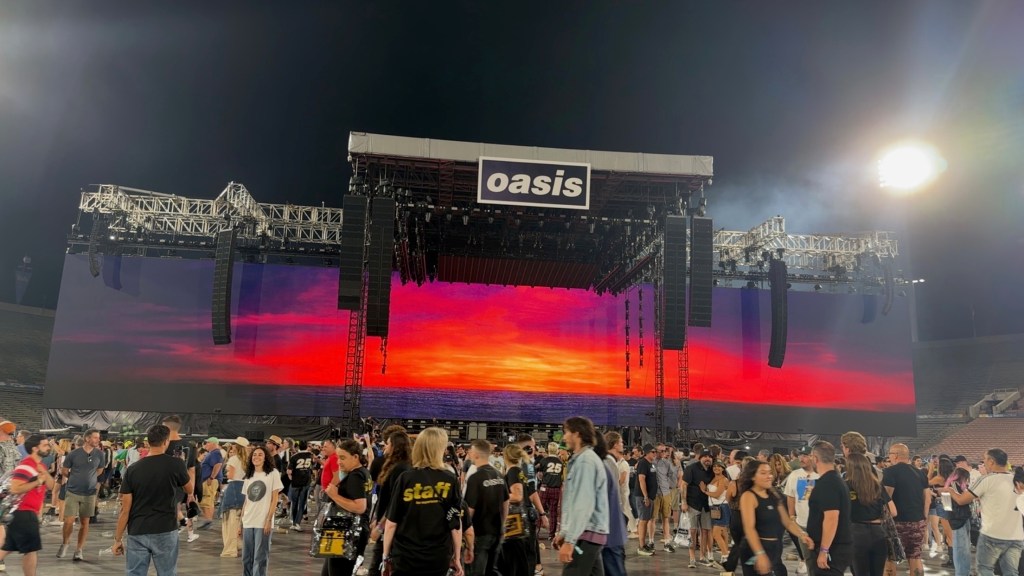
On Aug. 27, 2024, Oasis did the unthinkable: they announced their return. For years, talk of a reunion had been little more than pub chatter and wishful thinking, but that morning a cryptic post from the Gallagher brothers lit up the music world.
Three days later, on Aug. 30, the U.K. and Ireland presale opened; by the 31st, the general sale had wiped every ticket clean in hours. By September, billboards were flashing across North America, South America, Australia and Asia, confirming what fans everywhere already knew: Oasis weren’t just back — they were taking over again.
When the U.S. dates dropped, the reaction was staggering. Five stadiums sold out in under a day — nearly half a million tickets for a band that was never an American chart giant. “Wonderwall” remains their only U.S. top-10 single, peaking at No. 8 in 1996, and by the late 2000s Oasis were struggling to fill arenas.
I saw it myself: 16,574 fans at the Hollywood Bowl in 2005 for the Don’t Believe the Truth tour — almost a sellout, though many admitted they came for Jet, the Australian openers. Three years later, at the Staples Center for the Dig Out Your Soul tour, only 9,000 showed up. The upper deck was empty, and Liam and Noel barely acknowledged each other. From that night on, it felt like the road had ended. Which is why, when American stadiums sold out in 2024, it seemed unreal — and why Liam could throw it back at us on X: “America, you have one last chance to prove that you loved us all along.”
The truth was, the shows I’d seen in America never felt like the Oasis I had grown up dreaming about. That dream came from Familiar to Millions, the Wembley concerts of July 2000, when 70,000 people each night (140,000 across two shows) sang as one voice inside the old stadium before its demolition. That was the Oasis show I thought I’d see someday, and when Noel walked away in 2009, I thought the chance was gone. So when the reunion was announced, I didn’t hesitate. I bought a ticket to Edinburgh — and tickets for both nights at the Rose Bowl.
I flew into Scotland on Aug. 6, two days before the gig, and it was clear before I even reached Edinburgh that Oasis weren’t just returning — they’d taken over the country. In Glasgow, pubs blasted Morning Glory on repeat, kids on the high street strolled in Adidas tracksuits and bucket hats, and half the conversations you overheard were about which night people were going to Murrayfield. The band wasn’t in town yet, but their shadow was everywhere.
When I arrived in Edinburgh, the atmosphere felt close to bursting. August is already festival season, when the city’s streets are swollen with tourists, comedians and performers. Add in an estimated 70,000 fans a night pouring into Murrayfield, and the place felt like it was vibrating on its foundations. These were the gigs being billed as the biggest stadium shows in Scottish history, and no one doubted it.
You could feel it on George Street, where an official Oasis pop-up shop had queues down the block. Fans walked out with Adidas x Oasis jerseys and armfuls of posters, comparing B-sides and setlist predictions as if they were trading cards. On the day of the show, the buildup spilled into the streets outside the stadium. Two girls had gone full Gallagher cosplay, Adidas tracksuits, bucket hats, wigs, even penciled-on stubble. One strummed a guitar while the other snarled into the air, and soon a circle of fans surrounded them, harmonizing to “Wonderwall.” It was clear: the concert hadn’t started yet, but Oasis were already everywhere.
Inside Murrayfield, the restlessness turned electric. Whole sections were already singing “Live Forever” before the lights dimmed, their voices echoing across the terraces. It was the perfect cue for Richard Ashcroft to step out. He wasn’t just an opener, he was Britpop royalty, the frontman of The Verve, a band that had risen alongside Oasis in the ’90s and carved its own place in the movement. The crowd greeted him like a brother returning home.
Before starting his final song, Ashcroft paused, grinning into the roar. “It’s been a pleasure opening for one of the greatest bands in the world, and I’d like to finish with one of the greatest songs of all time”. Then the unmistakable strings of “Bittersweet Symphony” began, and the stadium erupted. Arms shot into the air, strangers threw their arms around each other, and the chorus carried across 70,000 voices before Ashcroft even reached the mic. It was less an opening set than a reminder: Britpop wasn’t nostalgia that night — it was alive and still echoing through a new generation.
Ashcroft left the stage to a roar that refused to die down. The stadium lights stayed low, a restless hum sweeping through the terraces. People were stamping their feet, hugging strangers, shouting for the Gallaghers as if sheer noise might drag them out faster. Then the opening loop of “Fuckin’ in the Bushes” hit, snarling through the speakers like a starter’s pistol. The place erupted.
Out they came: Liam and Noel Gallagher, strolling with their arms draped across each other’s shoulders, a sight nobody thought they’d see again. Behind them, Paul “Bonehead” Arthurs, Gem Archer and Andy Bell took their places. For me, seeing Bonehead back on stage was surreal, the rhythm guitarist from the early days, standing there again, shoulder to shoulder with the Gallaghers, as if no time had passed.
Liam stepped up first, arms out wide. “Oasis vibes in the area. Edinburgh vibes in the area.” With that, the band launched into “Hello”. When Noel leaned into the mic to deliver the line, “It’s good to be back, it’s good to be back,” the crowd bellowed it straight back at him. The irony wasn’t lost, this was the same man who’d spent years swearing a reunion would never happen. Fans joked it might take divine intervention — or a divorce lawyer — to change his mind. Turns out the latter did the trick.
From there, Liam was all bite and swagger. Before “Acquiesce,” he shouted, “We’ve fucking missed you”.
Before “Cigarettes & Alcohol”, Liam leaned into the mic: “I’ve never asked you lot to do the Macarena or the Hokey Cokey, but I will ask you to all turn around and do the Poznań”.
For anyone outside the U.K., the Poznań is a terrace ritual — arms locked over shoulders, whole sections turning their backs and bouncing in unison — adopted by Manchester City from the Polish club Lech Poznań. At Murrayfield, it became something else entirely. Tens of thousands moved together, the stadium shaking under the weight of it.
Looking back, that was the moment I realized I’d finally experienced the Oasis concert I used to dream about as a kid. I had watched Familiar to Millions on DVD so many times, convinced I’d missed out on that kind of madness forever after Noel walked away. But in Edinburgh, it finally felt like I had stepped into that world, the storm wasn’t on a screen anymore; it was happening all around me.
Fans around me echoed that same feeling. Allan Muir, who first saw Oasis in 2005 at Edinburgh’s Usher Hall, told me the reunion felt different this time. “They opened with ‘Fuckin’ in the Bushes,’ then went straight into ‘Lyla.’ The crowd was mental”, he said. “That first time will always be hard to beat, especially in a small venue, but this time felt special. Most of us didn’t think it would ever happen again”.
Chris Tuffen, who caught Oasis back in 1994 at the Corn Exchange in Cambridge, had a similar reflection. “They were raw then, jeans, shirts, just ordinary lads who looked like us. They weren’t polished yet, but that’s what made it brilliant. You could feel the hunger. The reunion shows were great, but it’s never going to compare to being 50 yards away from Liam in ’94”.
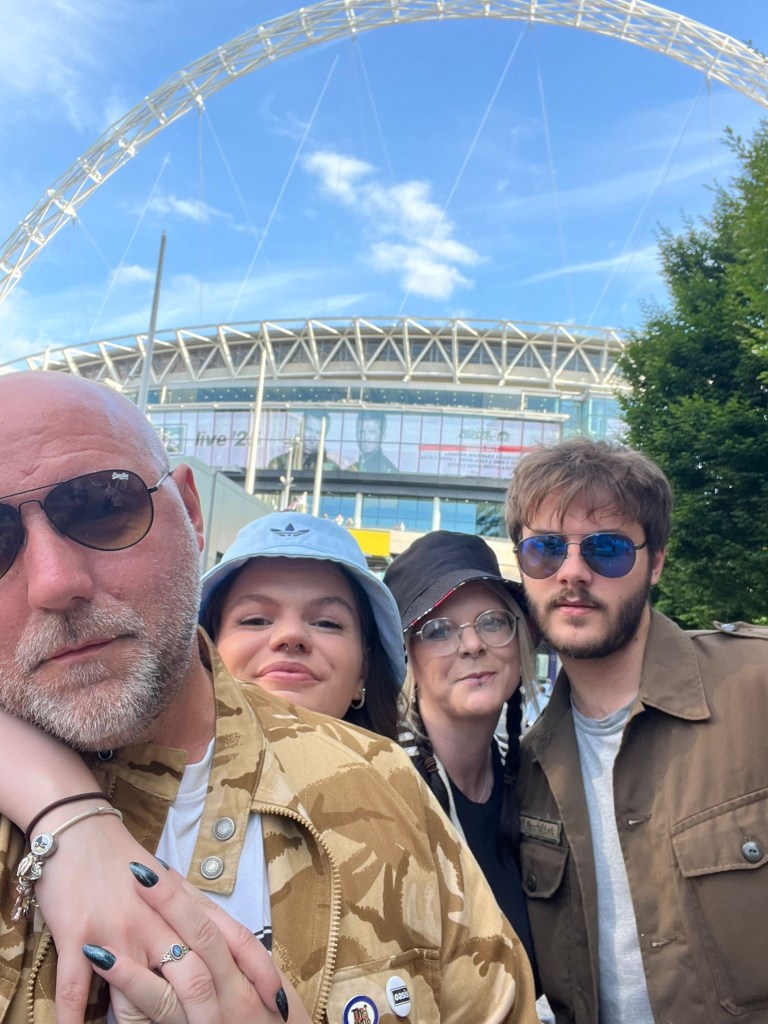
After, before “Fade Away”, Liam asked, “Do we have any people that have never seen us before? Shit loads. How does this feel? This one’s for you”. The roar was immediate. A group of teenagers right behind me screamed like they’d just been handed the keys to history. Their excitement was infectious — fists in the air, eyes wide, shouting back at Liam as if they’d waited all their lives for that invitation. In that moment, it hit me: this wasn’t just my memory lane. This was generational renewal.
I was no longer the 13-year-old at the Hollywood Bowl in 2005, nervously clutching a tour shirt too big for me, watching my first real gig unfold. Nor was I the 17-year-old at Staples Center in 2008, quietly clocking the distance between Liam and Noel onstage and wondering if the end was near. Instead, here I was, decades later, witnessing kids discover Oasis for the first time in the way I once did. It felt like a full circle closing — and opening again. A happy, almost defiant moment. Proof that this reunion wasn’t only about the past but about a future where new generations would carry these songs forward.
Walking out of Murrayfield, I thought nothing could top it. The bruises, the ringing in my ears, the feeling that I’d finally stepped into the storm I’d only ever seen on DVD, it all clung to me.
A month later, I was back in Los Angeles, this time at the Rose Bowl, standing in the pit for both nights. The difference was immediate. In Scotland, people were singing before the gates opened. In Pasadena, most were trying to take the perfect selfie. Halfway through the first night, fans were still queuing for merch, clutching drinks, phones raised high. For a pit, it was oddly calm.
A teenage boy next to me turned to his dad and said, “For Radiohead, I’m okay just being in the seats”. I saw a family with two toddlers running around the middle of the crowd, and for a moment I couldn’t decide if it was endearing or insane. Eventually, I slipped out to the bathroom just to breathe.
That’s where I met a man from London, leaning against the sink, eyes red with jet lag but smiling. “This is history”, he said. “I don’t care where I’m sitting or where I’m listening to them. They sold out the Rose Bowl”. His words hit me harder than I expected. He wasn’t wrong — Oasis had never sold out an American stadium before.
A Canadian woman I met outside later told me, “Oasis are loved in Canada, but someone once threw a shoe at Liam, and he’s never gotten over it”. We both laughed, but it was the kind of joke that said more than it should have.
Day one felt chaotic in all the wrong ways — people more focused on capturing proof than being present. Before “Cigarettes & Alcohol,” Liam leaned into the mic with a smirk. “As I was swimming this morning in Santa Monica,” he said, “this fucking shark jumps out — ‘Mr. Gallagher’, I said, ‘It’s Liam.’ He said, ‘Good luck trying to get that lot to do the Poznań. You know what L.A. crowds are like — all stoned out of their heads, in the sun all day’”. The crowd laughed. “But you got it in you?” he challenged, mimicking the shark doing the Poznań before launching into the song.
He wasn’t wrong about the crowd, though. Most didn’t move. The terraces rippled with confusion — a few half-hearted jumps, but nothing close to the unity of Murrayfield.
A TikTok user, @abibiscuit, later posted a clip titled “Me getting mad at my section for not doing the Poznań during L.A. night two.” In the video, she’s heard explaining, “You have to turn around… you have to jump”. I laughed watching it because that’s exactly what I’d done. I turned to the guy beside me and said, “Turn around — we’re going to jump”.
By night two, something shifted. Maybe word had spread, maybe people just loosened up, but the pit felt alive. I was lucky enough to be surrounded by fans who loved the band as much as I did — Brits, Canadians, City fans, even a few Americans who’d been following Oasis since the ’90s. When the Poznań came back around, we nailed it — arms over shoulders, backs turned, jumping in sync. It wasn’t 1996 Manchester, but it was close enough to feel the pulse of it.
Still, there were moments that showed how different the crowds were. When Noel introduced Paul “Bonehead” Arthurs, the reaction was polite — nothing like the roar that shook Edinburgh. Phones glowed through entire songs. Allan Muir told me part of what made those early gigs so special was the lack of distraction. “Enjoy it like it’s the last time you’ll ever see them”, he said. “Keep your phone in your pocket”. Chris Tuffen echoed that sentiment when I asked what had changed over the years. “Back then, no one had their phones out. Everyone was in the moment. That’s what made it magic”.
Even so, there was something undeniably touching about how the Gallaghers handled their return to an American stage. Liam was sharp, restrained, still snarling but softer around the edges. Noel, who’d spent decades swearing he’d never do this again, was in good spirits. He didn’t mock the crowd once. On the first night, he stopped mid-set to dedicate “Don’t Look Back in Anger” to a crying fan in the front row. It was small, but the entire stadium went silent before erupting into one enormous chorus.
Walking out of the Rose Bowl that second night, I realized what I’d been chasing. Edinburgh was energy; L.A. was emotion. But what Oasis meant — the reason they mattered — was something only people who’d lived through it could explain. Chris Tuffen tried.
Oasis weren’t just a band, they were a reaction to something broken. “The country was on its arse,” he said, remembering Britain under a conservative government, with pay cuts, rising taxes and mass unemployment. “Then this band that looked like 90% of the country stood up and sang about everyday shit and made us feel like rock ’n’ roll stars”. Songs like “Cigarettes & Alcohol” weren’t escapism, they were survival. Britpop, he said, gave people “a voice, a confidence, a swagger again”.
He wasn’t romanticizing it either. By 1997, when Princess Diana died, he said the country’s mood shifted, the swagger dimmed, the euphoria faded and that moment passed. But for those few years, Oasis changed everything.
Listening to him, I thought about Noel Gallagher’s intent when he wrote “Live Forever.” It was his rebuttal to grunge fatalism, his answer to Nirvana’s “I Hate Myself and I Want to Die”. Noel once said he couldn’t stand the idea of kids listening to misery from someone who had everything. He wanted to write something that made you want to live.
And maybe that’s what this reunion is doing again, just somewhere new. America feels heavy right now: uncertain, angry and divided, the same way Britain once was in the early ’90s. Oasis might not have meant to, but they’ve come back at the right time, to remind people, as Chris put it, to find “their confidence and swagger again”.
Maybe they arrived just when America needed a band that still believes in being loud, hopeful and alive.
 Bleu de minuit